domingo, 21 de octubre de 2012

CARNAVAL DE BARRANQUILLA


CARNAVAL DE BARRANQUILLA

Barranquilla's Carnival (Spanish: Carnaval de Barranquilla) is Colombia's most important folklore celebration, one of the biggest carnivals in the world. The carnival has traditions that date back to the 19th century. Forty days before Holy Week, Barranquilla decks itself out to receive national and foreign tourists, and join together with the city's inhabitants to enjoy four days of intense festivities. During the Carnival Barranquilla's normal activities are paralyzed because the city gets busy with street dances, musical and masquerade parades. Barranquilla's Carnival includes dances like the Spanish paloteo, African Congo and indigenous mico y micas. Many styles of Colombian music are also performed, most prominently Cumbia, and instruments include drums and wind ensembles. The Carnival of Barranquilla was proclaimed Cultural Masterpiece of the Nation by Colombia's National Congress on 2002. Also the UNESCO, in Paris on November 7, 2003, declared it as one of the Masterpieces of the Oral and Intangible Heritage of Humanity, and it was during Olga Lucia Rodriquez Carnival Queen year.

The Carnival starts on the Saturday before Ash Wednesday with the Battle of the Flowers, which is considered one of the main activities. Then, The Great Parade on Sunday and Monday is marked by an Orchestra Festival with Caribbean and Latin bands. Tuesday signals the end of the carnival, announced by the burial of Joselito Carnaval, who is mourned by everyone.
Barranquilla's Carnival slogan is: Who lives it, is who enjoys it (Quien lo vive, es quien lo goza).

The carnival queen is chosen at the end of the previous year so that she has time to prepare herself. The King Momo is also chosen around this time, and whoever is the queen or the king has taken part in the carnival since childhood and is well known for his carnival spirit. Rehearsals for the carnival start several weeks before the Carnival and every Friday of this season is Carnival Friday.
The Carnival Queen presides over the different events until the symbolic burial of Joselito Carnaval (Joseph Carnival). Carnival starts off with the Pre-Carnival activities. The festival officially begins with the “Lectura del Bando”, which is the traditional reading of the carnival proclamation. Here it is stated that everyone must enjoy themselves, dance and party wildly. Although the carnival officially initiates with this activity, in Barranquilla there is happiness and joy weeks before of this. The Pre-Carnival activities include the Lectura Del Bando, Toma de la Ciudad (Taking the City), the Crowing of the Carnival Queen and King, the Children’s Carnival Procession, and finally the most important pre-carnival event, La Guacherna. The Guacherna is a night parade of dances, Cumbias, and masquerades, which takes place a Friday before the Saturday of carnival.

The Carnival starts on the Saturday before Ash Wednesday with the Battle of the Flowers, which is the most important event of the carnival. The Battle of the Flowers is a traditional float parade composed of the greatest and most colorful creations. Approximately, is a six hour show of floats and it is led by the Carnival Queen followed by folk dances, musicians, dance groups, costumed groups, marchers, disguises and fire breathers. The audience can enjoy all the carnival characters here.

Sunday of Carnival is when the Great Parade takes place. It is considered a day of mask and disguises because floats are not present this day. Different dance groups compete against each other for the coveted prize of performing in the Battle of the Flowers the following year.
Monday is marked by an Orchestra Festival, with Caribbean and Latin bands from early afternoon until early Tuesday. The Festival involved various categories and groups that compete for the coveted Golden Congo.[3] The Fantasy Parade is also presented on Monday, and it is a very colorful parade in which all kinds of customs are seen.
Tuesday signals the end of the carnival, announced by the burial of Joselito Carnaval, who is mourned by everyone. Joselito, a character who symbolizes the joy of the festivities, who had resurrected the Saturday of carnival and dies on the last day tired and hungover to resurrect the following year in the next carnival. Tuesday`s parade is shorter than the other parades, and here happy widows participate crying because of this personage`s death. It is similar to burial. At night, a funny litany is celebrated with simple lines and its characteristic tone, and current national and international affairs are criticized. The next day is Ash Wednesday and Lent, a period of religious devotion and abstinence, begins.
All of the carnival events are often broadcasted live by regional television channels. The Carnival of Barranquilla is very important for the economy of the entire region. Tourism increases significantly these 4 days, which are holidays in Barranquilla.
MUSIC AND DANCING
The music contains a mixture of Cumbia, Porro, Mapalé, Gaita, Chandé, Puya, Fandango, and fantastic Merecumbé. These are examples of many styles of Colombian music. It is a party that gathers up tradition based on the creativity of the Colombian people, and it is expressed by various forms of dancing, by means of music, by different forms of art works, by the wearing of different costumes, and by the way of celebrating. The Carnival of Barranquilla is unique because of its cultural diversity and because it is a party where the people are the main protagonists. Every dance, every folkloric group, and every custom play different roles to make the party the best show on earth.

The Carnival of Barranquilla is multicultural, diverse, and rich in different cultural expressions. Its dancing and dancing expressions, just like its music, is gathered from every city of the Caribbean part of Colombia. The Carnival’s diversity can be categorized in seven different blocks: Traditional dances or folkloric dances; dances relation or manifestation dances; special dances or choreographic dances; “Comparsas” (a form of live music), with which the choreography and creativity of dances are expressed; Comedies, which are traditional and folkloric popular theater, where oral expression is its primary characteristic; Litany, which are traditional groups that sing along a choir; and last but not least the customs. These can be individual, or collectives, structural, and dramatic.
COSTUMES AND DANCES
“La Marimonda”, which are hooded figures with long noses, floppy ears and bright trousers and vests, is the most popular costume because it is the only costume that originated in Barranquilla. The rest of the costumes come from European or African origin.

Other traditional customs are El garabato, El Africano, Drácula, El torito, EL Congo, El Monocuco, Los Cabezones, Las Muñeconas, and El Tigrillo.
The Carnival´s dances are: La CumbiaEl Garabato, El Son de Negro, El Congo, El Mapalé, El Caimán, El Paloteo, El Gusano, Las Farotas, De Relación and Las Pilanderas.
"The Cumbia, a good example of the fusion of Indian, Black and White elements that simulates a couple courting and is characterized by the elegance and subtle movements of the woman’s hips to the rhythm of a drum and flute." Another of the main dances is the Garabato, which represents a mystical battle between life and death. The Congo represents African tradition in its movement and also the memory of slavery in America.


CARNAVAL DE BLANCOS Y NEGROS


CARNAVAL DE BLANCOS Y NEGROS

Blacks and Whites' Carnival (Spanish: Carnaval de Negros y Blancos), is the largest and most important celebration in southern Colombia, its geographical indication belongs to the city of Pasto (The Surprise City). It's celebrated from 2 to 7 January of each year and attracts a considerable number of Colombian and foreign tourists.
In 30 September 2009, this Carnival was proclaimed by UNESCO, as one of the Masterpieces of the Oral and Intangible Heritage of Humanity
Origins
Strictly speaking, the modern carnival, arise at the dawn of an Epiphany day in 6 January 1912, based on the need to express imagination, play, friendship and sharing the joy that around that time of the year revives. In a fine and exclusive brothel in the city, the House of the Misses Robby located in the Calle Real (Royal Street, current 25th Carrera), was the place where the audacity of Don Angel Maria Lopez Zarama, renowned tailor of the city, leads him to take the French face powder of one of the most requested ladies and proceeds to gently spread the powder and some woman's perfume among all those present with the slogan ¡Vivan los Blanquitos! (Hurray the Whiteys!). Soon, the companions of the master cutter and victims of the powder, join the game. Then, everyone would go out to repeat the joke with the unsuspecting parishioners exiting the Kings' Mass from the nearby church of San Juan Bautista, repeating: ¡Que vivan los Negros y que vivan los Blancos! (Hurray the Blacks and Hurray the Whites!) that expression under the custody of Galeras was inserted with force and forever into the essence of Pasto.

However, other cultures and expressions have contributed to the formation of the intricate identity of Pasto's Carnival festivities. This fact characterizes and differentiates it between similar expressions.
Its genesis is also rooted in the rituals performed by the Quillacingas, an agrarian culture, which, at harvest time danced honoring the moon and prayed to the sun, asking protection for their crops.

Carnival Stages
The carnival includes four major stages: the Carnavalito (Chlidren's Carnival), the Arrival of the Castaneda Family, Blacks' Day and Whites' Day with the Grand Parade (this being the most important day for its beauty). However, it's necessary to consider the pre-carnival activities and in recent years, 7 January is considered another carnival day for Remate (Finish) with the celebration of the "Cuy's festival" when locals and tourists delight the typical dish of the region.

Pre-carnival

In Colombia, end of year festivities include an extended period, starting 7 December with the celebration of the eve of the traditional feast of the Immaculate Conception of Mary or Día de las Velitas, continuing by the celebration of the traditional Novena (16 to 24 December) and the Catholic Christmas, which tends to extended until the feast of Epiphany or 6 January.
Within this context eminently festive, many secular celebrations are considered a preface to Blacks and Whites' Carnival, and in the city of Pasto is mainly performed on 28 December (All Fools' Day) and 31 (New Year's Eve).

Fools' Day (28 December)

Water Carnival
On 28 December, day of the Holy Innocents some Pastusos play with water in what may be considered a prelude to the January holidays, imitating carnival customs of the neighboring country of Ecuador where the Carnival of Quito (February or March) is characterized by the use of water fun. What was initially a day to do tricks, practical jokes, and spread hoaxes on the unwary, became a questionable game with water based in the desire to tease or surprise the unsuspecting, innocent pedestrians soaking them completely.
This custom is not fully accepted and enjoyed, especially when the average temperature of the city hardly exceeds 55° Fahrenheit.Although the authorities have sought to control through bans to waste water, the most practical solution to combat this phenomenon has found by EMPOPASTO (Pasto Water Company), that day used to perform maintenance work on its two networks, cutting off water supplies throughout the urban area of the municipality, like a big practical joke on the players.
Moreover, since the late twentieth century are advanced alternative activities that seek to provide the public recreation and culture without losing the carnival sense on 28 December among them are the innocent tour and the rainbow on the asphalt.

Rainbow in the Asphalt
In 1996, as a cultural and ecological alternative to the water carnival and collecting student initiatives from to the Arts Department of theUniversity of Nariño, establishing the proposed "Rainbow in the Asphalt". Through art and using the imagination, with the color of chalk on the gray concrete inviting to recover urban space and regain the sense of carnival and celebration. So the pre-carnival in general, has changed, which seek to keep the festive spirit through art, creating a new attitude to the festival and the city.


New Year's Eve Puppets (31 December)

The 31 December of each year, Pasto streets are filled with dolls or puppets made from old clothes, paper and sawdust (formerly gunpowder) to represent the old year which will end at midnight when they are burned in a ritual with remote and deep meanings. From earlier in the day, kids who go to eager passersby with money requests such as "alms for the old year, please" and "widows" usually represented by men transdressed with dark veils aid request for "decent burial or cremation" of the "deceased year", after midnight. The main event of the day with crowd participation is a competition of the puppets are paraded through the main streets usually represent political allegory, in which year the dying leaves in a "testament" full of ironies, summarizing all that has shown relevant in that year for the city and country. The creators of the best puppets, receive cash prizes.
Thus ensuring a healthy and dignified spectacle. The winning design is burned in the Plaza del Carnaval at the end of that day, amid the popular festivities which usually organize the municipal authorities to receive the new year, and may in fact at that time the city begins to be invaded with playful and cathartic spirit of near carnival.
Starting in 2006, was banned the sale of Christmas gunpowder in the city, as established by Decree 0207 April 2005 as Mayor of Pasto and Corpocarnaval are the only entities authorized to organize events with fireworks to welcome the new year


PALIO DI SIENA

PALIO DI SIENA


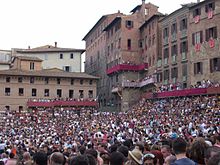
The Palio di Siena (known locally simply as Il Palio) is a horse race that is held twice each year, on July 2 and August 16, in Siena,Italy. Ten horses and riders, bareback and dressed in the appropriate colours, represent ten of the seventeen contrade, or city wards. The Palio held on July 2 is named Palio di Provenzano, in honour of the Madonna of Provenzano, who has a church in Siena. The Palio held on August 16 is named Palio dell'Assunta, in honour of the Assumption of Mary.
A magnificent pageant, the Corteo Storico, precedes the race, which attracts visitors and spectators from around the world.

The race itself, in which the jockeys ride bareback, circles the Piazza del Campo, on which a thick layer of dirt has been laid, three times and usually lasts no more than 90 seconds. It is not uncommon for a few of the jockeys to be thrown off their horses while making the treacherous turns in the piazza, and indeed, it is not unusual to see unmounted horses finishing the race without their jockeys.

Origins

The earliest known antecedents of the race are medieval. The town's central piazza was the site of public games, largely combative:pugna, a sort of many-sided boxing match or brawl; jousting; and in the 16th century, bullfights. Public races organized by the contradewere popular from the 14th century on; called palii alla lunga, they were run across the whole city.
When the Grand Duke of Tuscany outlawed bullfighting in 1590, the contrade took to organizing races in the Piazza del Campo. The first such races were on buffalo-back and called bufalate; asinate, races on donkey-back, later took their place, while horse racing continued elsewhere. The first modern Palio (calledpalio alla tonda to distinguish it from the earlier (palii alla lunga) took place in 1656.


A second Palio in August

At first, one race was held each year, on July 2. A second, on August 16, was added from 1701, though initially, the August race was run intermittently rather than every year. The August race (il palio dell'Assunta), which coincided with the Feast of the Assumption, was probably introduced "spontaneously" as part of the feasting and celebration associated with this important festival. August 16 was presumably chosen because the other days of the mid-August canonical festival, the 14th and 15th of the month, were already taken up respectively by the Corteo dei Ceri (Procession of the Ceri) and by the census.
The August Palio started out as an extension of the celebrations of the July Palio and was organized and funded by July's winning contrada, though only if the contrada in question could afford it. After 1802, however, organisation and funding the August race became a central responsibility of the city, which removed annual uncertainty over whether or not an August Palio would run.
It was originated in 1581 on August 15.

Restriction

In 1729, the city's Munich-born governor, Violante of Bavaria, defined formal boundaries for the contrade, at the same time imposing several mergers so that the number of Sienese contrade was reduced to seventeen. This was also the year of the decree restricting to ten the number of contrade that could participate in a Palio; the restriction, which remains in force, resulted from the number and extent of accidents experienced in the preceding races.