.jpg/424px-Arrivo_lg_il_palio_del_16_agosto_2006_(16).jpg)
PALIO DI SIENA
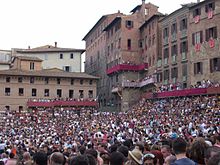
The Palio di Siena (known locally simply as Il Palio) is a horse race that is held twice each year, on July 2 and August 16, in Siena,Italy. Ten horses and riders, bareback and dressed in the appropriate colours, represent ten of the seventeen contrade, or city wards. The Palio held on July 2 is named Palio di Provenzano, in honour of the Madonna of Provenzano, who has a church in Siena. The Palio held on August 16 is named Palio dell'Assunta, in honour of the Assumption of Mary.
A magnificent pageant, the Corteo Storico, precedes the race, which attracts visitors and spectators from around the world.
The race itself, in which the jockeys ride bareback, circles the Piazza del Campo, on which a thick layer of dirt has been laid, three times and usually lasts no more than 90 seconds. It is not uncommon for a few of the jockeys to be thrown off their horses while making the treacherous turns in the piazza, and indeed, it is not unusual to see unmounted horses finishing the race without their jockeys.
Origins
The earliest known antecedents of the race are medieval. The town's central piazza was the site of public games, largely combative:pugna, a sort of many-sided boxing match or brawl; jousting; and in the 16th century, bullfights. Public races organized by the contradewere popular from the 14th century on; called palii alla lunga, they were run across the whole city.
When the Grand Duke of Tuscany outlawed bullfighting in 1590, the contrade took to organizing races in the Piazza del Campo. The first such races were on buffalo-back and called bufalate; asinate, races on donkey-back, later took their place, while horse racing continued elsewhere. The first modern Palio (calledpalio alla tonda to distinguish it from the earlier (palii alla lunga) took place in 1656.
A second Palio in August
At first, one race was held each year, on July 2. A second, on August 16, was added from 1701, though initially, the August race was run intermittently rather than every year. The August race (il palio dell'Assunta), which coincided with the Feast of the Assumption, was probably introduced "spontaneously" as part of the feasting and celebration associated with this important festival. August 16 was presumably chosen because the other days of the mid-August canonical festival, the 14th and 15th of the month, were already taken up respectively by the Corteo dei Ceri (Procession of the Ceri) and by the census.
The August Palio started out as an extension of the celebrations of the July Palio and was organized and funded by July's winning contrada, though only if the contrada in question could afford it. After 1802, however, organisation and funding the August race became a central responsibility of the city, which removed annual uncertainty over whether or not an August Palio would run.
It was originated in 1581 on August 15.
Restriction
In 1729, the city's Munich-born governor, Violante of Bavaria, defined formal boundaries for the contrade, at the same time imposing several mergers so that the number of Sienese contrade was reduced to seventeen. This was also the year of the decree restricting to ten the number of contrade that could participate in a Palio; the restriction, which remains in force, resulted from the number and extent of accidents experienced in the preceding races.
.jpg)

That good blog is very important to know about the culture of our Colombia its partys, its people...
ResponderEliminar(BY: Leidy Yurany Rojas C.)
I feel great this blog
ResponderEliminarvery interesting for us to know about all these holidays.
By:Yuly Paulin Mainguez Taborda